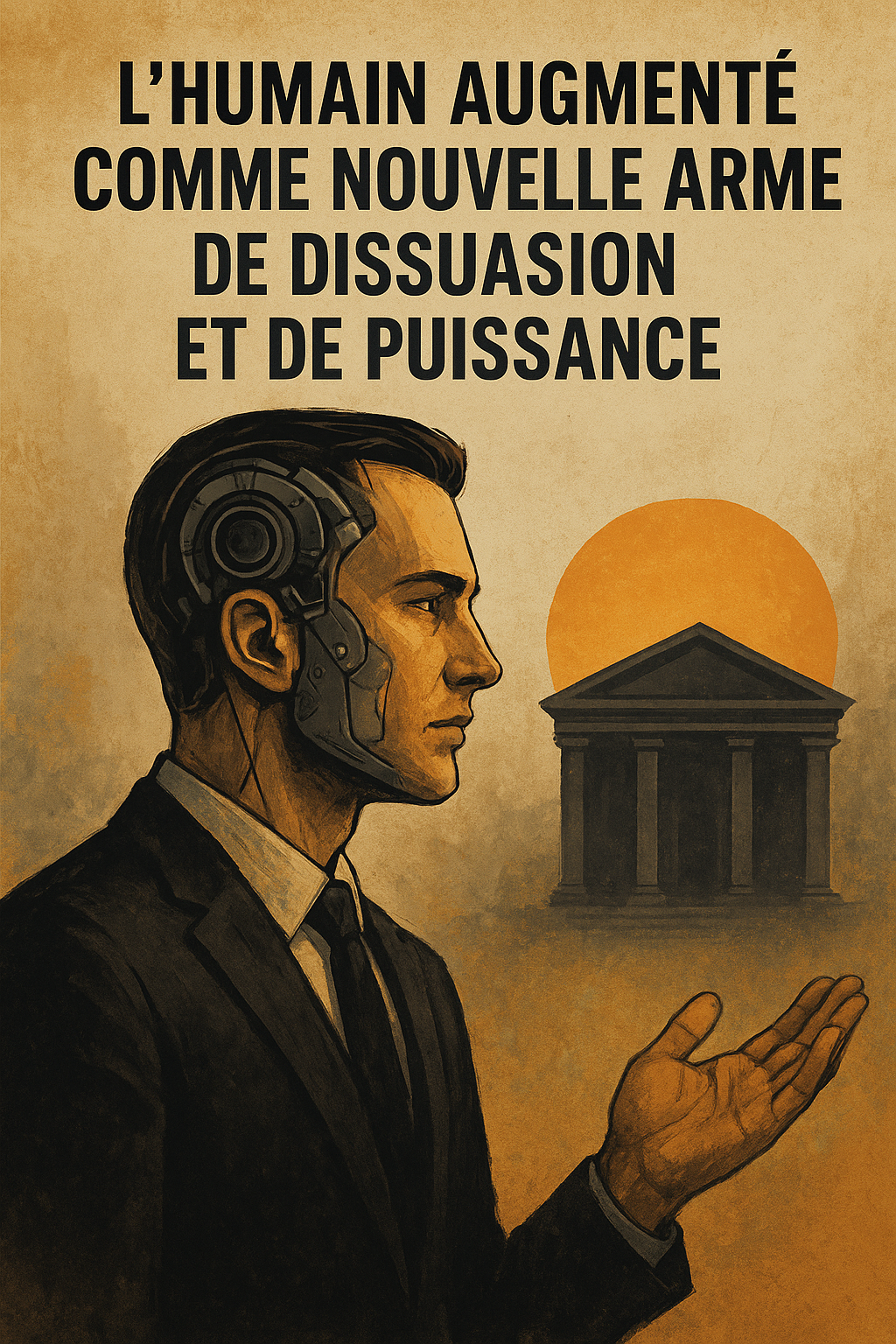
Reflection – In a world where weapons are shared by all major powers, civilizational domination might no longer come through direct warfare, but through... gray matter.
The end of conventional weapons as the sole factor of domination
For centuries, power has been measured by number of soldiers that a state could mobilize. Then came the nuclear age, where a handful of men were enough to annihilate an entire planet.
Today, this ultimate weapon has lost its value: whoever used it would be signing their own death warrant. The atomic weapon is no longer a viable weapon, but merely a deterrent.
Bacteriological weapons? Same problem. Those who had the misfortune to release a virus from a laboratory did so either by mistake or strategically. But it was the flu, and a much more deadly virus could decimate the entire planet, and that wouldn't necessarily be in the interest of whoever gave the order, except in a purely Malthusian logic, which isn't impossible, but let's move on.
The information weapon? It is becoming commonplace, and although today's propaganda continues to be done via mainstream media, it is no longer really necessary, as the masses are so anesthetized.
Today, as economic wars rage between different blocs, we are currently witnessing a race for the "lethal weapon" of the future : It is the weapon of intelligence, as well as artificial, than human.
This weapon would thus allow the major powers to mastering the technological leap we are currently experiencing. And empires that miss the boat are likely to fall and... return to the Stone Age, in a kind of unenviable retro-futuristic Mad Max, of which Europe and France are on the front line.
Technology as a new deterrent
Power is now being played out on the field. economic and technological. The one who controls the data, the algorithm, the automation, the robotics, and the energy controls the world.
However, technology alone is no longer enough. Access to knowledge has been democratized: everyone can now learn anything. The challenge is therefore no longer simply having access to information, but first and foremost having desire to learn, and then of know what to do with it.
In other words, artificial intelligence has reshuffled the cards: it has propelled us into a new playing field that leaves no room for mediocrity or idleness., She has "raised the bar"«. While some consume it as a simple personal assistant to get answers to everything, others use it to improve themselves., strengthen their brain and become true gymnasts of the intellect.
Therefore, in this new context, the challenge of tomorrow is not only to master AI, but also and above all to transforming data into meaning, value, and power. And this is not achieved with masses of uninformed consumers, but with augmented humans.
The augmented human: the alchemist of the 21st century
The augmented human is not necessarily the one who is equipped with neural prostheses or nanotechnologies.
It is above all the one who merges its biological intelligence with artificial intelligence to gain a competitive advantage, but also a civilizational ideal.
The augmented human is the modern alchemist: he transforms the flow of information into ideas, strategies, creations, innovations and societal projects.
It's the engineer who knows how to communicate with AI. The researcher who thinks faster and further thanks to their own cognitive tools, while also leveraging technology. It's the visionary business leader who goes beyond what AI might dictate. It's the artist or philosopher who transcends the machine through meaning.
In other words: the true deterrent of the 21st century will be to "own" a trained, sharp, agile, ethical and creative population — a superior humanity not through domination by arms, but through mastery and intelligence.
Ethics as a strategic dimension
Furthermore, in a world saturated with technology, paradoxically, the human soul becomes rare and could therefore become valued. This scarcity confers a unprecedented symbolic power.
The West long dominated the world thanks to its moral promise—human rights, freedom, dignity, reason—in addition to its technological advancements. But these foundations have been shaken: wars of intervention and political hypocrisy have undermined its reputation.
The result: the moral authority of the West is crumbling, while other powers are asserting themselves with narratives of rigor, duty, cohesion and morality.
The race for technology cannot be won without an ethical and cultural renaissance. For the societies of the future will need not only engineers, but also guardians of meaning. Men and women capable of combining technological power and moral high ground.
However, this rise in moral competence requires, once again, intelligence. And whatever one might say, as technology improves the level of knowledge, and as information becomes more accessible (and we're not talking about information for the general public here), it's clear that populations are paradoxically becoming increasingly susceptible to any seriousness.
In other words, recent experiences have shown us that questioning authority, even when it raises ethical questions, does not seem to be a priority for public opinion…
Mastering technology alone might give a civilization a short-term advantage, but human beings remain human beings, with their own sensitivities and a moral compass more or less shared by all humanity for millennia. Mastering technology without a moral vision is therefore bound to create resentment, and then challenges to authority.
The powers that can balance technology and a shared vision for society could become the big winners of tomorrow.
Europe facing its decline
And in Europe, that's where the problem lies. Europe is the heir to the Enlightenment and Romanticism, and this heritage has given it a very pleasant way of life. It has therefore become complacent in its post-industrial comfort.
Her youth was first lulled by leisure, then by anguish (idleness alone inevitably leading to a loss of meaning and therefore to unhappiness). She distanced herself from physical and intellectual work, as well as from discipline, which she considered unfulfilling activities, ultimately ending in a final, desperate act by gradually sinking, without realizing it, into the downgrading.
And the word "downgrading" is chosen deliberately here, since it is not only a social downgrading at the national level, but also a global downgrading at the economic, but also intellectual and educational level.
Meanwhile, China is training cohorts of young programmers from childhood. The United States is merging capitalism and artificial intelligence in a Darwinian dynamic. Their societal project is far from ideal, and the antithesis of French romanticism, but it has the merit of being pragmatic and effective.
And Europe, for its part, is drowning in administrative and procedural abysses, by trying to keep its large, Soviet-era bureaucratic machine alive. Worse still, it seems to have drowned in an excess of democracy, spending its time legislating on this or that detail, crushing every pocket of freedom in its path, and therefore any impulse of creativity and genius.
This proliferation of regulations reflects less a concern for justice than a fear of disorder, a symptom of an aging civilization that no longer believes in the spontaneous virtue of its citizens. Europe, once a laboratory of intellectual courage and creative freedom, has become a bureaucracy of precaution. It protects itself from itself through regulations, exceptions, forms, and consents.
Where the individual should strive for excellence, he conforms. And this is precisely what threatens European genius today—this capacity to dare, to transgress, to invent. By trying to control everything, Europe has deprived itself of what constituted its greatness: confidence in the human spirit, and in the intelligence of each individual.
His only salvation: reinvest in education, rigor, effort, research, curiosity, and individual morality.
Because without it, Europe, and in particular France, will become the stowaways from a future invented by others. And to top it all off, our country will be nothing more than a tourist destination frozen in an Amélie Poulain-esque setting (which was innovative for its time but has become a sad cash cow), surrounded by cities riddled with insecurity and poverty.
Survival through elevation
The weapons of the future may therefore no longer be solely nuclear or bacteriological. Nor solely technological. They will be human, intellectual and civilizational, in the sense that the winning societies of the future will know how to define themselves as human societies, with a shared project and destiny, and a taste for individual intelligence and self-improvement, and not as metaverses of isolated individuals without social ties, fueled by the consumption of digital content, who have transferred their responsibility to a welfare state in complete disarray.
The augmented human might not be the cyborg we might have imagined, but An enlightened citizen who knows how to use their tools. This would be a human being with a vision, an ideal of society, and not a slave to their screens.
A person capable of educating themselves through technology, of informing themselves without being molded by their free will, and of using technology without being consumed by it. This is someone who reads, learns, understands, acts, and cultivates their lucidity.
And above all, it is the one who refuses to be trampled on by a state that is too welfare-oriented and not welfare-oriented enough, that confuses protection with infantilization. Tomorrow's competition may therefore be played out among "enhanced" citizens, brilliant, capable of critical thinking, lucidity, intelligence, and courage.
The future belongs to those who can unite the head, the hand and the heart — the three organs of true power.

Leave a Reply