
Intermediate Management Balances are different indicators that explain, in a way, the path that leads to a company's result.
This content is part of the course “Business Management for Entrepreneurs: A Complete Course to Better Manage Your Business” find it on Tulipemedia.com 💰📈
Indeed, there are an infinite number of ways to arrive at a net result, whether positive or negative, and the SIGs are the different milestones that illuminate the financial analysis on how a particular company arrived at a result.
Two companies with two identical results can have completely opposite performances, and GIS is one way to know which company is struggling or not compared to the other.
Net income, which is derived from the income statement, is therefore not a reliable indicator when considered in isolation. Analyzing a company's margins thus requires the use of key performance indicators (KPIs), which we have already discussed in previous sections of this course, particularly in the chapter on added value. Here, however, we will delve deeper into these various balances and take the opportunity to gain a comprehensive overview of them within the income statement.
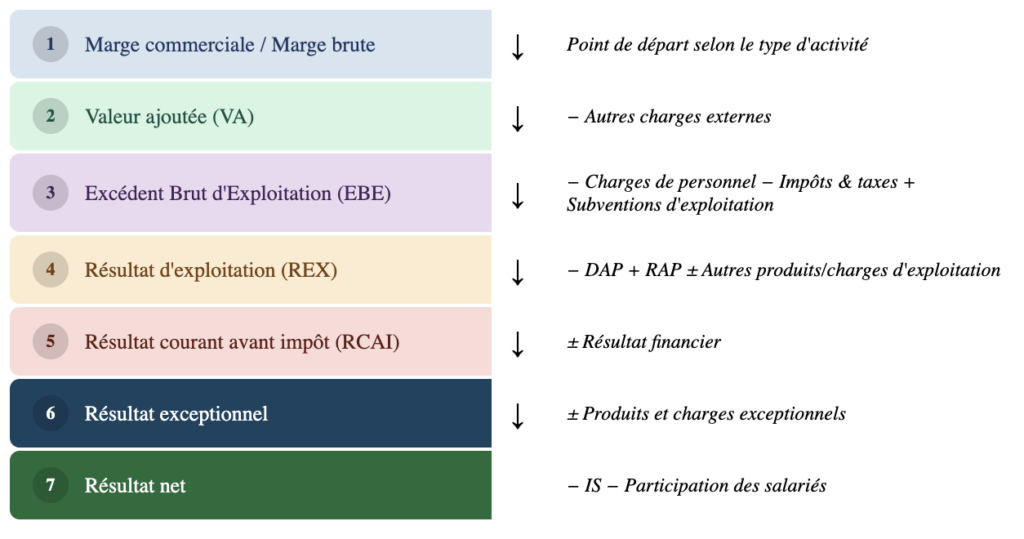
Just as the functional balance sheet is a restated accounting balance sheet in order to have a "financial" view, the SIG is also a way to "restate" the income statement in order to break it down into a form that groups expenses by nature, and thus to explain the different stages that mark the financial year of a company from its turnover to its net result.
Do you have a business and want to regain control of your margins and your business model? Discover my solution Ultimate Business Dashboard which transforms your raw accounting data into performance indicators and a monthly dashboard.
Remember, in the lesson on the income statement, we had already established a draft of the management information systems (MIS) via an "analytical" income statement, which we presented as follows:
| Cycle | Detailed items (PCG) | Formula / Comment |
|---|---|---|
| Operating cycle | Production of the exercise:
Other operating income:
– Consumption and operating costs:
|
= Gross Operating Surplus (GOS) |
| Investment cycle | – Depreciation and provisions (operating expenses) + Reversals of depreciation and provisions |
= Operating profit (EBIT) |
| Funding cycle | + Financial income – Net financial expenses – Allocations to financial provisions | = Current result before tax |
| Non-recurring transactions | + Exceptional income – Exceptional expenses – Allocations to exceptional provisions | = Exceptional result |
| Final result | – Employee profit-sharing (if applicable) – Income tax | = Net result |
This income statement includes some intermediate management balances such as EBITDA, but it is missing others, such as added value or gross/trade margin, which we will deal with here.
We therefore understand that ultimately, it is all about breaking down the profit and loss statement into different items, in order to arrive at the net result, and thus be able to explain it in different ways.
Revenue
The first key performance indicator (KPI) is simply the company's revenue. It is relevant to compare it from one year to the next, in order to know if it is increasing or decreasing, by simply calculating a rate of change.
At this stage, depending on whether there is an increase or decrease in turnover, the questions that will arise will be to understand the reasons for the change in turnover, and in particular to know whether this change is due to an increase in prices (due to inflation or an upgrade in quality or a need to cover increasing costs), or to a decrease in prices which would allow a larger sales volume, etc…
Revenue includes all invoices related to the company's main activity, and depending on the nature of this activity, it comes from the following items:
- Sales of finished products (account 701) → industrial or craft businesses that manufacture/transform products from raw materials.
- Sales of goods (account 707 of the PCG) → typical of trading companies (buying/reselling).
- Services provided (account 706) → firms, consultants, services.
These amounts are aggregated into a single line "Net Sales" in the official income statement.
Production (sold, stored, fixed assets)
The production of this exercise comprises 3 positions:
- the production sold (or CA), valued at the selling price; ;
- the stored production, therefore not yet sold, and which is valued at cost price (what it cost to produce these goods or services), and which can be linked to current assets in the balance sheet; ;
- Fixed production, which represents what the company has produced for itself (for example, a restaurant that has coded its own inventory management tool using AI), is again valued at cost price.
Production is therefore calculated as follows:
Production = Sales (or Revenue) + Stored Production + Capitalized Production
Regarding its interpretation, if for example the production of the exercise experiences a strong increase which is not really correlated with an increase in turnover from one year to the next, questions must be asked about possible overproduction, or about an increase in the cost of current assets (which reminds us of the problems of working capital requirements), or about a large investment linked to a fixed asset.
Finally, a suddenly high level of fixed production can be a way to artificially increase a company's products (and therefore its revenues), in order to artificially improve the final net result, since the net result is the fruit of this production (this is what we will see at the end with the calculation method).
Gross margin and trade margin
Next, we have the concepts of gross margin and trade margin. We already discussed these in the previous chapter on added value. Gross margin concerns companies that transform raw materials (industrial companies, restaurants, etc.), and trade margin concerns buying and reselling activities (trading companies).
As a reminder, in terms of semantics, "goods" refers to what is bought and resold as is (for example, an e-commerce site for buying and reselling sneakers), while "raw materials and other supplies" refers to what is intended to be transformed (for example, wheat flour into bread).
The profit margin
Let's start with the profit margin, which is calculated as follows:
Gross profit margin = Sales of goods − Cost of goods sold
With: Cost of goods sold = Purchases of goods + (Beginning inventory of goods − Ending inventory of goods)
Through this calculation, we seek to avoid placing undue burden on the exercise that the cost of the goods actually sold. Goods still in stock at the end of the accounting period have not yet generated revenue: their cost remains on the balance sheet, not in the income statement. This is why we add the cost of goods purchased to the difference between the beginning and ending inventory: if the ending inventory is higher than the beginning inventory, the value becomes negative, and it is subtracted from the cost of goods purchased, because this inventory has not yet been sold.
From the gross margin, we can calculate the gross margin rate (Gross Margin / Revenue).
Gross margin
Gross margin, on the other hand, applies to companies that transform raw materials (industry, restaurants, crafts, etc.). It is calculated as follows:
Gross margin = Production for the period − Consumption of raw materials and other supplies
With: Production for the year = Revenue + Stored production + Capitalized production
And: Consumption of raw materials and other supplies = Purchases of raw materials and other supplies + (Beginning stock of raw materials and other supplies − Ending stock of raw materials and other supplies)
Unlike the profit margin, here we are reasoning about the production and not solely on turnover, in order to integrate on the one hand the wealth not yet monetized by sales (stored production), and on the other hand the productive efforts carried out on behalf of the company itself (fixed production).
In both cases, the logic is the same: only what was physically consumed or sold to generate revenue is deducted, before taking into account operating expenses (personnel, rent, depreciation, etc.). This is what distinguishes gross margin from added value, which also includes other external expenses.
Note: In the functional presentation (IFRS standards), a line item also called "gross margin" appears in the income statement, but it covers a broader concept—the cost of sales as defined by IFRS includes production personnel and depreciation, not just raw materials consumed. The same term is used for different scopes, which can lead to confusion when comparing different accounting frameworks.
Gross margin = Production – Raw material and other supply costs
Be careful not to confuse raw material consumption in gross margin with intermediate consumption in value added. The term "intermediate consumption" can be misleading because its scope varies depending on the context in which it is used.
In calculating gross margin, intermediate consumption is limited to raw materials and supplies consumed—that is, only what has been physically incorporated into the production process. That's why I specified "raw material consumption" in the formula.
In calculating added value, intermediate consumption has a broader meaning: it encompasses both raw materials consumed AND all other external expenses (rent, energy, fees, subcontracting, advertising, etc.), that is, everything the company has purchased from third parties to operate, whether goods or services. We will examine this further in relation to added value, which is another intermediate management balance.
The hierarchy is therefore as follows:
Gross margin = Production − consumption of materials and other supplies
Added value = Production − material consumption − other external costs
In other words, added value starts with the gross margin and then deducts everything the company has outsourced. It thus measures the wealth actually created by the company itself, independently of its service providers.
And when we start with the income statement by nature (the table accessible at the beginning of this course), we see that to arrive at the gross margin and the trade margin, we must in fact "adjust" operating subsidies and other operating income, meaning we don't include them in the gross margin calculation, and "reinstate" the purchases of goods (sold) and raw materials (consumed). To better understand this process, an animation will be available a little further down.
From an interpretative standpoint, a gross margin that grows more slowly than revenue can signal an increase in raw material costs or a decline in production efficiency—it's a warning sign regarding upstream cost control, regardless of any considerations of overhead costs.»
To return to the gross margin and the commercial margin, during the financial analysis, we can compare the evolution of this margin with that of the turnover, and possibly with the evolution of total production (especially if there have been no upheavals at the level of fixed production).
Regarding inventory variation
Change in raw material and other supply inventories
A small digression concerning the variation of stocks, the formula for which is Initial stock of MP − Final stock of MP.
The fundamental economic formula is:
Consumption = Purchases + (Beginning Stock − Ending Stock)
Except that in practice, we sometimes do not have the initial stock and the final stock, but only an income statement, and a "Change in stock" line located either in expenses or in revenue.
The simple rule to apply:
- If the change is in expenses, it increases consumption. Therefore: Consumption = Purchases + Change; ;
- If the change is in products, it decreases consumption. Therefore: Consumption = Purchases − Change.
| Situation | Economic reality | Accounting translation |
|---|---|---|
| Clearance sale | Ending stock < beginning stock | Variation in loads |
| Storage | Ending stock > beginning stock | Product variation |
So :
- A charge corresponds to an additional cost.
- A product corresponds to a reduced cost.
Change in merchandise inventory (purchase/resale)
Regarding the variation in inventory (trading activity), the logic is exactly the same. There is simply a change in terminology (consumption becomes the cost of purchasing goods sold), but the economic reasoning is strictly identical.
- Goods → sales logic
- Raw materials → production logic
But in both cases:
- Stock variation is used to correct purchases
- the rule for addition/subtraction is the same
Therefore, a single mental rule can be used for both cases (goods bought and then resold on one side, raw materials and supplies used to be transformed into finished products on the other):
- Stock decreases → we consume / sell → we add
- Stock increases → we store → we subtract
The only difference is the name of the balance, since goods relate to the trade margin, and production relates to the gross production margin.
Added value
Normally, added value should no longer hold any secrets for you. It reflects the wealth created by the company through its activity, and the sum of the added values of all companies forms the Gross Domestic Product.
Added value is calculated as follows:
VA = Gross margin – Other external charges
or, alternatively, VA = Gross Profit – Other External Expenses
Other external charges relate to all charges that were not directly related to the purchase of raw materials and other supplies as well as the purchase of goods, and that are external to the company.
This includes rent, energy, water, upkeep and maintenance, small equipment, supplies, insurance, advertising costs, printing costs, commissioned marketing studies, subcontractors, freelancers, temporary workers, fees (lawyers, accountants…), software, transport, travel, postal costs, telecommunications costs, bank commissions (related to SMEs, and not those related to loans), miscellaneous expenses, etc…
The added value of a company is primarily an indicator intended to be compared with that of the sector to which the company belongs.
Gross Operating Surplus
EBITDA is arguably the most widely used metric in financial analysis. It measures the wealth generated by operating activities before any financing decisions (loans or equity) and before any depreciation choices.
It is therefore a "pure" performance indicator, independent of the company's accounting and financial choices.
EBITDA = Added value + Operating subsidies − Personnel expenses − Taxes
Personnel costs include gross salaries and employer social security contributions.
Taxes and duties here refer to operating taxes or certain local taxes (property tax, CFE, apprenticeship tax, etc.) — not to be confused with corporate tax, which comes much lower.
EBE is often likened to the Anglo-Saxon EBITDA (Earnings Before Interest, Taxes, Depreciation and Amortization), although the two are not strictly identical in their construction.
Difference between EBE and EBITDA
The difference between EBE and EBITDA lies in two points:
- Operating subsidies: EBITDA includes operating subsidies received by the company (public aid related to current activity), which EBITDA does not systematically isolate in the same way depending on the accounting standards used.
- Other operating income and expenses: EBITDA, as defined in the French GAAP (PCG), stops before "other operating income and expenses" (which are taken into account at the operating income level, which we will see shortly). EBITDA, on the other hand, is calculated from net income by working backwards—it includes interest, taxes, depreciation, and provisions, which may lead to the inclusion of certain items that the PCG would classify differently.
In practice, for a standard French company without significant subsidies or unusual factors, EBITDA and EBE are very similar and often used interchangeably in financial discussions. The distinction becomes more relevant in multi-criteria analyses or in in-depth international comparisons.
EBITDA (in France) and EBITDA (internationally) are the benchmark indicators for comparing operating profitability between companies, as they neutralize the effects of depreciation and financing policies which vary from one company to another.
A negative EBITDA (or EBE) is a serious warning sign: it means that current business is not generating enough wealth to cover even wages and taxes, before repaying debts or amortizing investments.
Operating Profit
You already know this from the income statement. Following the logic of management information systems (MIS), we arrive at it from EBITDA by incorporating the company's investment decisions:
REX = EBITDA − Depreciation and amortization (DAP) + Reversals of depreciation and amortization (RAP) ± Other operating income and expenses
Depreciation charges reflect the progressive depreciation of fixed assets—it is at this stage that they are included in the calculation, not before. This is precisely why EBITDA is exempt: two identical companies with different investment policies (one leases its machines, the other buys and depreciates them) will have different operating incomes but comparable EBITDA.
Other operating income and expenses include all items related to the company's day-to-day operations that do not fall into any of the categories already discussed. These are, in a way, the "miscellaneous" items in the operating budget.
Examples of products include: patent or license royalties collected, rents collected on real estate owned by the company, reimbursements of expenses by third parties, or insurance compensation related to operations.
On the expense side, there may be royalties paid, customer receivables written off as losses, or commercial penalties related to current business activity.
The distinction between an operating and an exceptional item (which we will discuss later and which concerns exceptional events) is sometimes subtle but rests on a simple criterion: if the event is related to the normal and recurring activity of the company, it is classified as an operating item; if it is one-off and unrelated to regular activity, it is classified as an exceptional item. For example, a penalty for late delivery in a company that regularly delivers to customers would be classified as an operating item, while a tax penalty would be classified as an exceptional item.
These elements come into play in the transition from EBITDA to EBIT, which explains why two companies with identical EBITDA can show different EBIT if one of them receives royalties on patents or suffers losses on receivables.
Current Profit Before Tax (CPBT)
The RCAI (Recurring Operating Income) incorporates the company's financial dimension — essentially the cost of its debt (loan interest) and the income from its investments. It is referred to as "current" income because it excludes any exceptional items: it reflects the company's normal and recurring performance over a fiscal year.
RCAI = REX + Financial Income − Financial Expenses
This is a very useful indicator for isolating the impact of the financial structure: by comparing operating income (EBIT) and net operating income (NOI), we can measure the burden of debt on profitability. A NOI significantly lower than EBIT indicates a highly indebted company.
The Exceptional Result
The Exceptional Result includes all events that are not part of the ordinary business: disposals of fixed assets, penalties, fines, compensation received or paid…
Exceptional result = Exceptional income − Exceptional expenses
As we saw in the chapter on the profit and loss statement by function, this concept does not exist in IFRS — the corresponding items are either integrated into operating profit or presented in the notes.
Net Result
Net income = EBITDA + Exceptional income − Employee profit-sharing − Corporate income tax
This is the final balance, the one shown on the balance sheet, which can be distributed to shareholders (dividends) or retained to strengthen equity. It is often less relevant than EBITDA or operating profit for comparing companies, as it includes non-recurring items and is heavily dependent on tax choices.
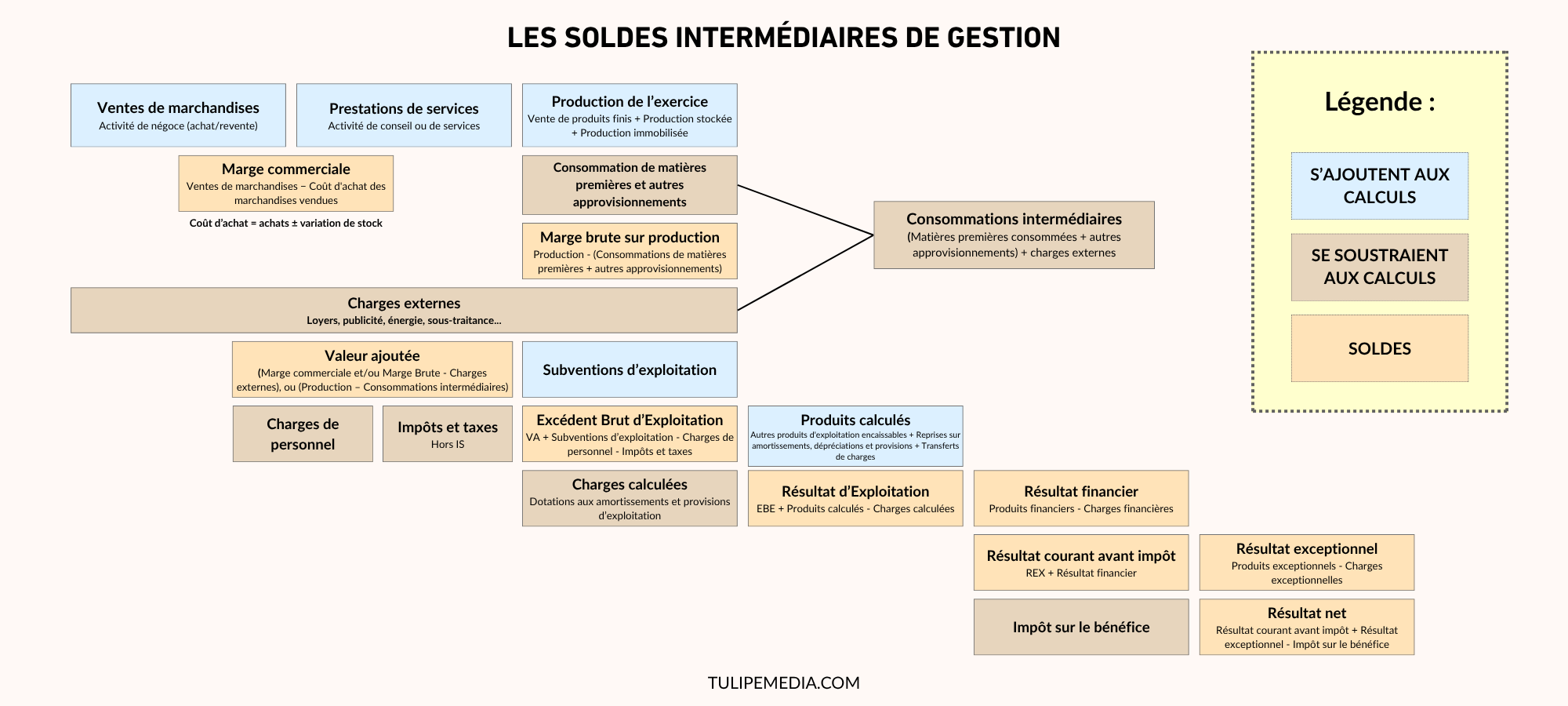
Summary diagram of intermediate management balances
Here is a clear and simple diagram of GIS to help you understand and remember it easily (you can click on it to enlarge):
GIS summary video
Here is an animation that shows how to move from a "PCG" type (by nature) profit and loss statement to Intermediate Management Balances, in order to fully understand the reasoning and process of each balance:
Key takeaways from the GIS cascade
Each GIS answers a specific question:
| SIG | A question to which he responds |
|---|---|
| Gross/commercial margin | Is my main activity profitable in terms of direct costs? |
| Added value | What wealth does my company actually create? |
| EBITDA | Does my farm generate cash, regardless of my financial choices? |
| REX | Is my investment policy sustainable? |
| RCAI | Is my debt putting too much of a strain on my profitability? |
| Exceptional result | Are there any specific events that disrupt the reading? |
| Net result | What remains to be distributed or put into reserve? |
Case study: Establishing key performance indicators (KPIs) from an income statement
Statement
ALPHA SARL provides you with its simplified profit and loss statement for the financial year N (amounts in thousands of euros):
| Charges | Amount | Products | Amount |
|---|---|---|---|
| Operating expenses | Operating income | ||
| Purchases of goods | 130 | Sales of goods | 200 |
| Purchases of raw materials | 80 | Production sold | 300 |
| Other purchases and external charges | 30 | Stored production | 20 |
| Change in inventories (goods and raw materials) | Included in the purchases above | Reversals of depreciation and provisions | 15 |
| Staff costs | 120 | ||
| Taxes and duties (excluding corporate income tax) | 20 | ||
| Depreciation and provisions (operating expenses) | 75 | ||
| Financial charges | Financial products | ||
| Financial charges | 35 | Financial products | 25 |
| Exceptional charges | Exceptional products | ||
| Exceptional charges | 25 | Exceptional products | 40 |
| Profit tax | 25% | ||
| Total | 540 | Total | 600 |
Using this income statement, calculate the following balances in succession. For each balance, clearly state the formula and the result (in thousands of euros), and give a short explanation (1 sentence) for each balance (what it measures).
- Trade margin (margin on buying/reselling goods)
- Gross production margin (margin on production activity)
- Added value
- Gross Operating Surplus (GOS)
- Operating Profit (EBIT)
- Current profit before tax (CPBT)
- Exceptional result
- Pre-tax result
- Net result
Corrected
Gross profit margin = Sales of goods – [Purchases of goods + (Beginning inventory of goods – Ending inventory of goods)] = 200 – 130 = 70
Gross margin = Production – (Purchase of raw materials and other production-related supplies + (Beginning raw material inventory – Ending raw material inventory)) = 320 – 80 = 240
Added value = Gross production margin + Commercial margin – Other external expenses = 240 + 70 – 30 = 280
EBITDA = Value Added – Personnel Expenses – Taxes (excluding corporate income tax) = 280 – 120 – 20 = 140
REX = EBITDA – Depreciation and Amortization + Reversals = 140 – 75 + 15 = 80
Financial result = -10
RCAI = REX + Financial Result = 80 – 10 = 70
Exceptional result = +15
Profit before tax = 70 + 15 = 85
Corporate tax (calculated on RCAI) = 70 × 25 % = 17.5
Net result = 85 – 17.5 = 67.5
Short explanation:
- Gross profit margin: Profitability of the pure activity of buying and reselling goods.
- Gross production margin: Margin made on the transformation/production of goods or services.
- Added value: Wealth actually created by the company (after consumption of external goods and services).
- EBITDA: Ability to generate operating cash flow before financing and taxes.
- REX: Performance of current operating activities.
- RCAI: Recurring performance (operations + financing).
- Exceptional result: Non-recurring and unusual elements.
- Profit before tax: Overall profit before taxation.
- Net result: Final profit after tax (distributable or to be carried forward).
From a strictly accounting point of view, the IS would be calculated on the accounting profit before tax (ABT).
Conclusion
Management information systems (MIS) are a powerful financial analysis tool precisely because they do not simply provide a final result: they break down the formation of that result step by step, making it possible to identify at what level of the activity the company's strengths and weaknesses lie.
A disappointing net result can therefore have very different origins depending on where the cascade deteriorates: a problem at the level of the gross margin points towards supply costs or productive efficiency, a drop at the level of EBITDA suggests an excessively heavy payroll, a large gap between EBITDA and REX questions the investment policy, and a RCAI much lower than REX signals excessive debt.
Without GIS, all these situations would lead to the same net negative result, without us knowing where to look.
It is important to keep in mind that GIS are primarily useful for comparison: comparison over time (changes from one exercise to another), comparison with competitors or sector averages, and comparison between different levels of the cascade within the same exercise.
Taken in isolation, an EBITDA or an EBITDA doesn't tell much — it's their evolution and their contextualization that give them meaning.
Finally, as we have seen throughout this chapter, key performance indicators (KPIs) are a construct specific to the French accounting framework (PCG). In an international context or for listed companies applying IFRS standards, the benchmark indicators are different — EBITDA, EBIT, operating profit — but the logic of cascading and progressive decomposition remains exactly the same.
Mastering GIS also means giving yourself the keys to understand and reprocess any profit and loss statement, regardless of the reference system.