
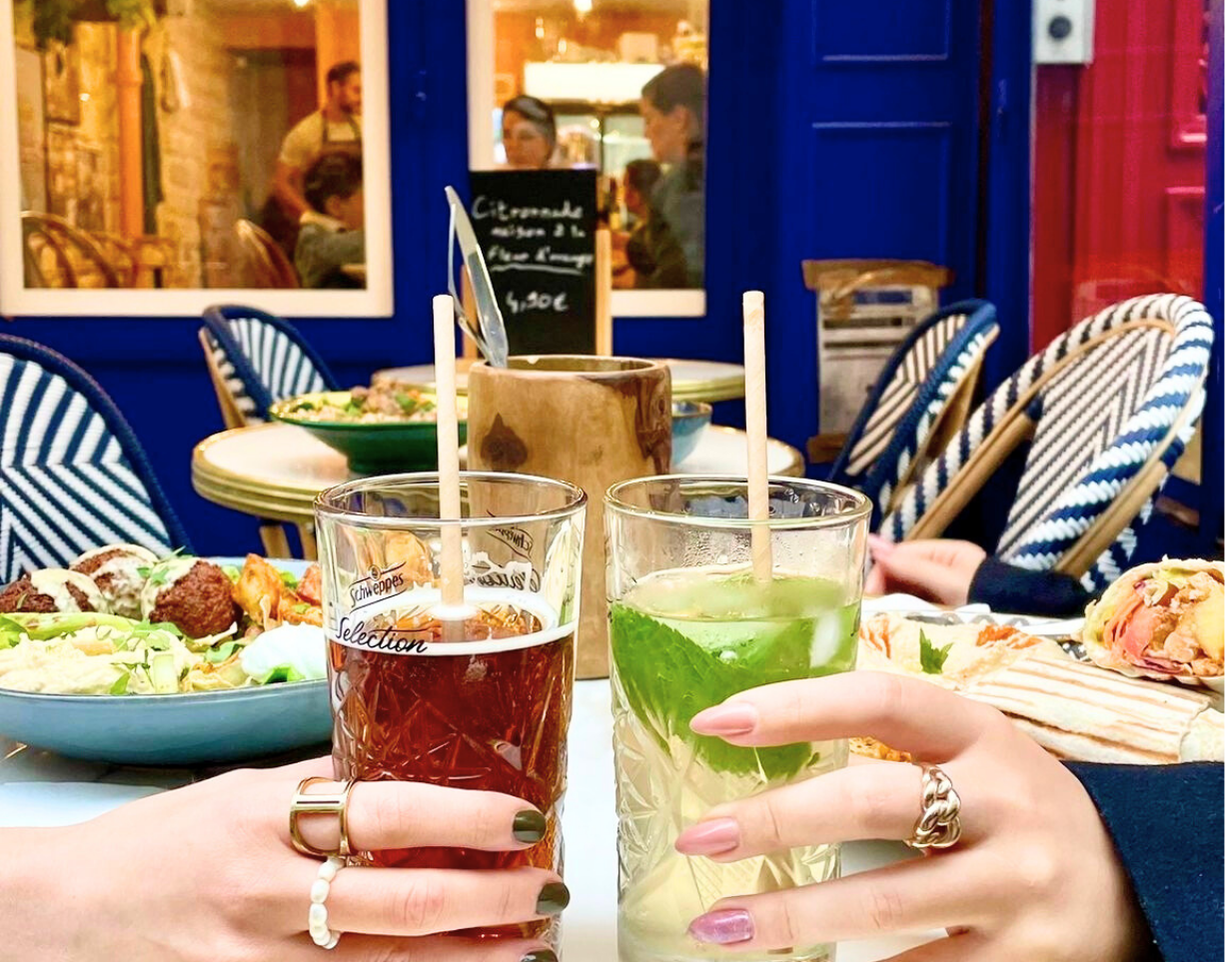
Your customer isn't reading your website; they're looking for three pieces of information.
Put yourself in his shoes. He's out on the street or on his sofa, phone in hand, and he's asking himself three questions: is it open, what do they serve and how much does it cost, and how do I make a reservation or order? If he can't find the answer in a few seconds, he'll go to the restaurant next door.
The direct consequence: your website must be designed primarily for mobile, load quickly, and display opening hours, address, and a clear call-to-action button ("Book" or "Order") on the first screen. The nice text about the history of the establishment can be kept, but placed further down.
The map: in actual text, not PDF
This is the most common mistake. The scanned map in PDF format, unreadable on a phone, shows last year's prices. A text-based map on a proper website page is:
- readable on mobile without zooming in; ;
- read by Google : someone searching for "hummus Paris 13" might stumble upon you; ;
- can be changed in two minutes when a price changes or a dish disappears; ;
- the ideal place to point out the allergens and vegetarian options, which more and more customers are looking at before making a choice.
And one beautiful photo of each signature dish is worth more than twenty average ones. Your customers eat with their eyes first, both on the website and on Instagram.
Booking: a button visible everywhere
If you take reservations, the button must be present on every page, at the top of the screen. Forget the "send us a message to reserve" contact form: nobody expects an email reply to find out if they have a table tonight.
In terms of tools, two models are in opposition:
| Model | Examples | Indicative cost | For whom |
|---|---|---|---|
| Commission-based platform | TheFork | A monthly subscription, plus a commission of a few euros per cover brought in from the platform | Restaurants that need the platform's visibility to fill up |
| Commission-free software | Zenchef, Eat App, Guestonline… | A fixed subscription, ranging from a few hundred to a few hundred euros per month depending on the modules | Restaurants that already have their clientele and want to keep their profit margin |
The right calculation isn't "which is the cheapest," but "how many bookings does the platform actually bring me?" If your customers already find you through Google or word of mouth, paying a commission on each one is like paying for customers you already had. In any case, the booking widget should be integrated into your website, not just accessible on the platform.
Fan of the WordPress ecosystem? Discover the best of my articles on WordPress as well as my WordPress extensions to make your site shine!
Click and collect and delivery: regaining control of your profit margin
Delivery platforms have become essential, but they are expensive. In France, Uber Eats' commission will from approximately 15 % to over 30 % of turnover excluding VAT According to the formula, this is before additional costs and advertising. In a business where the net margin often hinges on just a few points, that's huge.
I'm not saying you should abandon the platforms: they bring in new customers, and that's their real value. But every customer who orders a second time should be able to do so directly, on your website, via click and collect or delivery, without commission. An online ordering module on your own site, a QR code on bags and receipts, a small incentive for direct ordering, and some of your regular customers will switch over.
To be found: Google first, your website second
For a restaurant, the first point of contact isn't the website, it's the Google listing. That's where the choice between you and your competitor is made: photos, reviews, opening hours, directions button. The website supports this, to reassure and convert customers. I detailed the method in my article for Create an irresistible Google Business Profile.
The two need to talk:
- The same information everywhere The name, address, telephone number, and opening hours are identical on the website, Google listing, and platforms. This also applies to public holidays and exceptional closures.
- One page per establishment If you have several, include their address, neighborhood, opening hours, and menu if they differ. This is what allows you to appear in searches for "Lebanese restaurant Paris 13" and not just your name.
- Structured data (the "Restaurant" markup that Google and search engines read) so that the hours, price range and type of cuisine are understood without ambiguity.
And this is increasingly true with AI assistants. When someone asks ChatGPT or Gemini for "a good Lebanese restaurant near me," they draw on this same publicly available information. A clear website and an up-to-date Google listing are also what make you visible to them.
Things you don't need
- The full-screen video that starts playing upon arrival. It looks great on a computer, but it slows everything down on mobile, where your customers are.
- Animations in every direction. They impress on the day of the presentation, then become annoying.
- A blog that no one will update. It's better to have no news than to have the last news item dated 2023.
- Dozens of pages. Welcome, menu, reservation or order, establishment(s), contact: for most restaurants, that's enough.
This can bring in a lot of money
Once the essentials are in place, a few pages can generate real additional revenue, which is often overlooked:
- Catering and corporate events. Team lunches, buffets, seminars: orders worth hundreds or thousands of euros. A dedicated page with a well-designed request form and a fast quote process behind it. That's what I implemented at Libshop, with a tool that generates a quote in three minutes instead of an hour.
- Privatization. Birthdays, farewell parties, company events: one page with capacity, packages and a form.
- Gift cards. Sold online, paid for immediately, and used later.
- Recruitment. In the restaurant industry, finding staff is a constant struggle. A "We're Hiring" page that makes people want to join the team saves time.
The restaurant website checklist in 2026
| Essential | Useful | Bonus |
|---|---|---|
| Opening hours, address and telephone number on the first screen | Order online (click and collect, delivery) | Gift cards |
| Text-based map, up-to-date, readable on mobile | One page per establishment | recruitment page |
| "Reserve" or "Order" button on all pages | Catering or private event page with form | Newsletter signup |
| Fast and mobile-friendly website | Allergens and vegetarian options | English version for tourist areas |
| Linked Google listing, identical information everywhere | Structured data "Restaurant"« | Photo gallery of the room and the team |
In terms of budget, expect to pay between €2,000 and €4,500 excluding VAT for a custom restaurant website including a menu, booking and ordering system, and proper local SEO. A detailed breakdown is available in my article on [link to article]. the price of a WordPress showcase website.
Frequently Asked Questions
Does a restaurant really need a website if its Google listing and Instagram are up to date?
To get started, a well-maintained Google listing is a great start. But without a website, you have no control over how your menu is presented, direct orders, or catering and private event requests. And you're entirely dependent on platforms that can change their rules overnight.
WordPress or an all-in-one solution for a restaurant?
The all-in-one solutions offered by some point-of-sale or booking software are convenient for getting started, but you don't truly own the site and it's difficult to expand further. WordPress requires a bit more setup, but you own your site and can integrate the tools of your choice.
Can we keep a map as a PDF in addition to the map page?
Yes, as an add-on, for those who want to print it. But the main map must be a full page of text, otherwise Google won't read it and neither will your mobile customers.
How long does it take to put a restaurant website online?
Allow three to six weeks. As always, what pushes the schedule back is the photos and the updated map, not the technical aspects. Plan the photo shoot well in advance.

Leave a Reply