

Each era has had its own management software
If we take a step back and look at thirty years of computing in businesses and organizations, the scenario repeats itself:
- The ERP (integrated management software) was created to bring together accounting, inventory, purchasing and production, which until then had been managed in software that did not communicate with each other.
- The CRM He brought order to the customer files scattered among salespeople, spreadsheets and address books. Here again, it was a matter of gathering the data.
- The HRIS did the same for payroll, leave and personnel files; ; the CMMS for maintenance; ; the CMS for website content; ; the PIM for product sheets.
- SaaS then switched everything to a subscription model, with a much more accessible barrier to entry.
- And all this without even mentioning the integration and automation platforms (Zapier, Make and others), responsible for circulating data between dozens of applications.
Each time, the same mechanism: a wave of scattered tools, then a central system that restores order. The current wave is called AI. And it's much faster than the previous ones.
The problem: AI galore
Today, in many companies, AI is being implemented like SaaS was ten years ago: marketing has its text generator, sales its prospecting assistant, accounting its invoice reading tool, customer service its chatbot, and each employee has opened their own account on two or three AIs, with their own skills. No one has an overall view.
It works very well locally, but it can quickly turn into a complex system, with overlapping tools, accumulating subscriptions, cobbled-together automations that only their author understands, and questions regarding governance and security.
Start with the needs, not the tools
The first correction is simple, and it has nothing to do with technology: stop asking "where can we put AI?" and go back to "what is making us lose time, money or customers?".
A need, an objective, an indicator. Only then do we choose the tool. And sometimes, the tool isn't even AI. In my catering quote automation, The calculation does not use any AI: a price must be exact, not "probable". AI has its place elsewhere, for reading a request or writing a message, or for developing the tool.
But starting with needs isn't enough when you have hundreds of needs, dozens of tools, and thousands of collaborators. You need a system to make them work together.
The AI of AIs: a conductor for all the others
This would be a system that does not replace any of your AIs, but makes them work together, like ERP did in its time for accounting, inventory and purchasing.
Here's how I imagine it.
A conductor who understands the overall context
The AI of AIs would know which AIs are running in the company, what they are used for, what data they have access to, which employees have access to it, and which processes they affect.
When a need arises, it doesn't launch a new tool: it activates the right AIs, in the right order, providing them with the correct context. A customer request can thus be read by one AI, enriched by the CRM, quantified by a calculation tool, and then drafted by another AI, without anyone having to manually make the connection.
The right model for each task
Not all models are created equal, and they don't all cost the same. Sorting emails requires a different kind of brainpower than analyzing a contract.
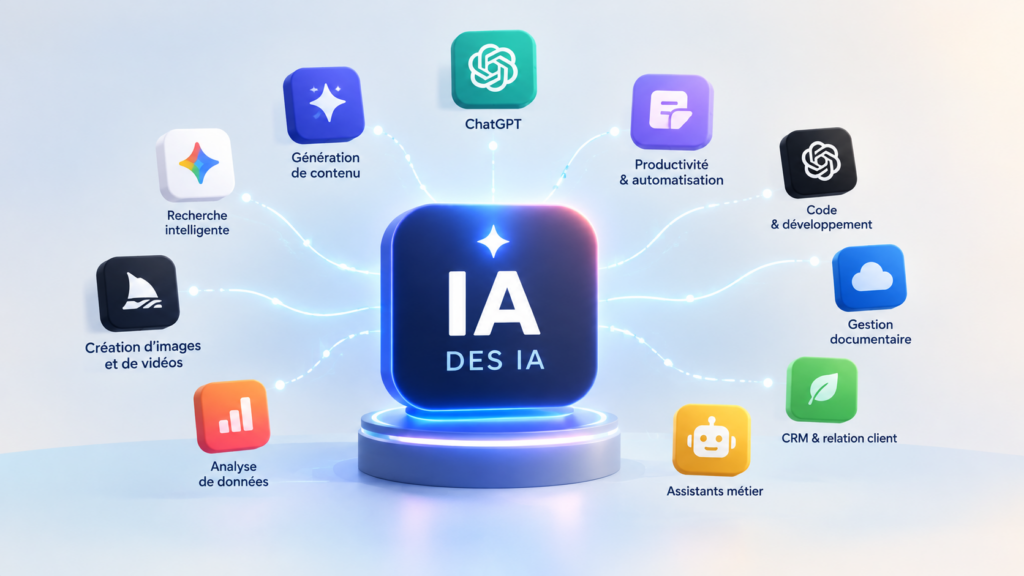
The AI of AIs would choose the right model depending on the context: a small, fast, and economical model for simple tasks, a powerful model for complex reasoning, and an internally hosted model when the data is sensitive. And it can switch providers if a model becomes better or cheaper, without the business users even noticing.
Feedback, monitoring and automatic correction
An AI that silently makes mistakes is more dangerous than an AI that crashes.
The AI of AIs would continuously monitor AI agents: response quality, errors, processing time, costs, abnormal behavior. When something goes wrong, it would automatically correct what can be corrected (restart a task, change the model, revert to a previous version) and alert a human for the rest.
Over time, it would optimize processes: it would identify slow, costly or unused automations, and suggest improving or eliminating them.
Reports and logs for the IT department and management
Everything each AI does is tracked: who requested what, which AI acted, on what data, with what result, and at what cost. The IT department finds the information needed for security and auditing. Management finally finds the answer to the question everyone is asking: what does AI really bring us?
A console where everyone expresses their needs
Finally, a console where everyone could use it for their specific business needs would, in my opinion, be the centerpiece.
Rather than auditing teams, formalizing a statement of needs, gathering data, processing it and then proposing solutions that are often complicated, costly and time-consuming to implement, we could embrace the risky side of using AI in its most hazardous aspects, allowing teams to express their needs in order to offer them "governance friendly" solutions thanks to the AI of AIs.
Each employee would thus have a chat, in the form of a conversation, where they would describe their daily irritation: "I spend two hours a week copying supplier orders into the spreadsheet" for example.
The AI of AIs, which understands the overall context, would propose automation using already validated tools and AI. If the need exceeds existing capabilities, it would escalate it to the IT department or management, with a qualified and quantified solution, instead of leaving the employee to tinker with a tool found online.
A very interesting side effect: a need expressed once benefits everyone. If three different departments request the same thing, the AI of AIs sees it, and automation becomes a shared service rather than three parallel workarounds.
What I would add to it
- A register and a life cycle. Each AI has a manager, a commissioning date, and a review date. An AI that is no longer needed is withdrawn, just as an employee's account is deactivated upon departure.
- The slightest privilege. An AI should never have more rights than the person for whom it works.
- One budget per service. The costs of using AI can skyrocket without warning. Consumption needs to be monitored daily, just like tracking an expense report.
- Non-regression tests. When a supplier updates its model, the responses change. A series of typical cases must be automatically replayed to verify that nothing has broken.
- An emergency switch. Being able to disable an AI, a supplier or an automation with one click, without stopping everything.
- Independence from suppliers. If your entire AI relies on a single actor, you are handing them the keys to the house.
- Integrated compliance. Between the GDPR and the European AI Act, traceability is no longer optional. A system that logs everything makes compliance a by-product, not a separate project.
Let's be realistic about the limits.
I would be dishonest to sell AI of AIs as a miracle solution. Three risks seem serious to me.
Recreate the gasworks one floor higher. Those who have experienced an eighteen-month ERP project know that a system meant to unify everything can become the company's biggest problem. AI should remain a lightweight management layer, not just another monster.
Omniscience comes at a price. A system that sees everything and acts everywhere is also a single point of failure and an ideal target for an attacker. Its security must be considered before its functionality.
An AI that corrects AIs is still an AI. Self-optimization can go astray: a system that seeks to reduce costs will ultimately degrade quality if no one monitors it. Automated corrections should be reserved for reversible actions. For anything that commits the company (a payment, a customer email, data deletion), human approval is obviously required.
And what does this mean in practical terms for an SME or an entrepreneur?
Major software publishers will fight to sell their platforms to large corporations, at corporation-level prices. But the need for structure is the same for an SME, a freelancer, or an infopreneur juggling ten AI tools. And the good news is that we can apply this logic right now, without waiting for the perfect software:
- Take inventory. A simple table: which AI, who uses it, for what purpose, with what data, at what cost and what gain. You always discover surprises.
- Establish three rules. The authorized tools, the data that you never put into an AI, and which validates a new automation.
- Centralize rather than pile up. A main assistant connected to your business tools (which is precisely what MCP connectors allow) often replaces several subscriptions, with a log of what has been done.
- Automate need by need, by measuring the time saved, and eliminating what doesn't bring any profit.
AI doesn't need to be everywhere. It needs to be in the right place, serving a purpose, and under someone's control. AI of AIs would simply be a way to industrialize this common sense. Companies that understand this early on won't have "more AI" than others: they'll have less, but AI that actually works.


Leave a Reply